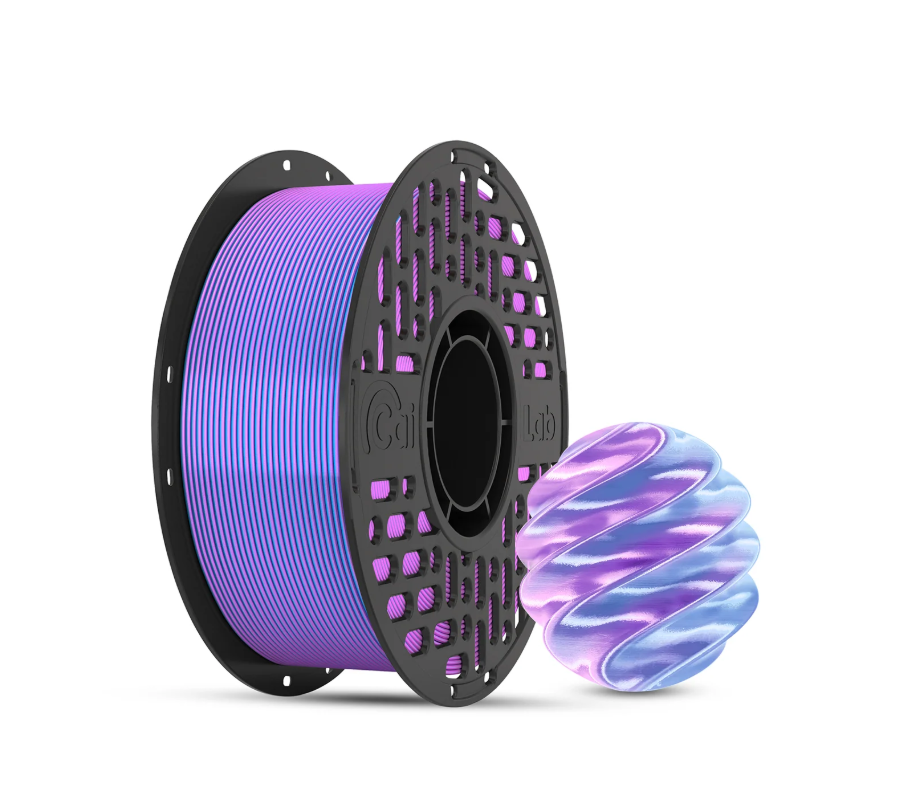
Color consistency has become an important consideration for distributors who serve hobbyists, design studios, print farms, and retail channels. When evaluating dual color PLA, buyers often look beyond appearance and focus on whether the color transition remains stable throughout an entire spool. Understanding the quality control process helps distributors judge material reliability before adding new products to their portfolios. Some manufacturers, including CaiLab, also explain how production testing supports more consistent printing results.
Why Color Transition Consistency Matters for Dual Color PLA
Unlike standard PLA, dual color PLA combines two colors into a single filament strand. As the printed model changes orientation, different colors become visible under changing light and viewing angles. This visual effect depends on maintaining a stable color structure across the filament.
If the transition between colors varies during production, users may notice unexpected visual differences between prints from the same spool. For distributors, inconsistent appearance may increase customer questions, product returns, or replacement requests. Stable manufacturing therefore becomes just as important as selecting attractive color combinations.
Raw Material Selection Supports Stable Appearance
A reliable color transition begins with consistent raw materials rather than only the coloring process. Resin quality influences extrusion behavior, dimensional stability, and pigment distribution during production.
CaiLab states that they source PLA raw materials from established suppliers such as NatureWorks. Stable resin characteristics help maintain predictable processing conditions, reducing variation that could affect how the two colors remain positioned within the filament cross-section.
Pigments also require careful formulation because uneven dispersion may change how the two colors appear after printing. Manufacturers generally verify pigment compatibility before introducing new color combinations into regular production.
Measuring Filament Geometry During Production
Filament diameter plays an indirect but important role in color transition quality. If diameter fluctuates, extrusion volume may become inconsistent, influencing surface appearance and layer formation.
Manufacturers typically monitor diameter continuously during extrusion using automated measurement systems. Maintaining dimensional consistency helps preserve steady material flow through the printer nozzle.
Distributors evaluating multi color PLA filament should also review published diameter tolerance information and confirm that production monitoring follows repeatable inspection procedures rather than relying only on random sampling.
How Cross-Section Inspection Verifies Color Distribution
One practical quality control method involves examining the filament cross-section after extrusion.
Technicians cut sample sections and observe whether both colors occupy the intended proportions. The dividing boundary should remain continuous rather than shifting irregularly along the filament length.
This inspection helps identify mixing problems before large production batches are completed. When manufacturers discover uneven distribution early, adjustments can be made before products reach distributors or retail customers.
Printing Validation Confirms Real-World Performance
Laboratory measurements alone cannot fully verify color transition effectiveness. Manufacturers usually perform print testing using representative printer settings to evaluate actual printing performance.
Printed samples allow inspectors to observe layer adhesion, extrusion stability, surface finish, and visual color changes under normal lighting. The objective is not only to confirm attractive appearance but also to ensure the color transition remains predictable across different model geometries.
For distributors, these practical validation tests provide useful evidence that production quality extends beyond basic dimensional inspection.
Multi Color PLA Filament Testing Across Continuous Production
Color effects should remain consistent from the beginning to the end of every spool.
Quality teams often perform sampling throughout production instead of inspecting only finished products. Continuous sampling allows manufacturers to detect gradual process changes caused by temperature variation, pigment feeding, or extrusion pressure.
This approach becomes especially useful for multi color PLA filament, where long production runs require stable process control to maintain the intended visual characteristics over the full spool length.
Production Validation Through Large-Scale Print Testing
Manufacturing validation becomes stronger when products are tested under large-scale printing conditions instead of only laboratory environments.
CaiLab operates a print farm with approximately 2,000 3D printers, allowing newly developed filament formulations to undergo extensive production-scale evaluation. Repeated printing helps engineers identify processing issues, evaluate consistency across multiple printers, and refine formulations before wider product release.
Large-volume testing also provides valuable information about how color transition performance behaves during extended printing jobs.
Packaging and Final Inspection Reduce Distribution Risks
Manufacturers generally inspect spool winding quality because uneven winding may create feeding interruptions during printing. Vacuum packaging with moisture protection helps preserve filament condition throughout transportation and storage.
Final inspection commonly includes label verification, product identification, packaging integrity, and appearance checks. These procedures reduce the likelihood of shipping errors while helping distributors receive products that match ordering specifications.
Quality Control Factors Behind Consistent Silk PLA Performance
Consistent printing results depend not only on filament design but also on quality control throughout material production. Key factors such as filament diameter accuracy, material composition, and color distribution need to be monitored to maintain stable extrusion performance across different batches.
CaiLab applies controlled production processes and repeated printing evaluations to verify filament performance before distribution. For example, their 1.75 mm silk PLA filament with a 1 kg spool format is tested for printing consistency, helping confirm that color transitions and extrusion behavior remain stable during regular FDM printing.
These quality control practices help distributors and professional users evaluate whether the material can meet the requirements of different application scenarios, including hobby projects, design prototypes, educational models, and printing services.
Choosing Products Based on Verified Quality Evidence
When distributors evaluate dual color PLA, appearance alone should not determine purchasing decisions. Reliable color transition depends on raw material consistency, stable extrusion control, dimensional inspection, cross-section analysis, practical print validation, and thorough final inspection.
Manufacturers that combine production monitoring with large-scale printing verification provide distributors with additional confidence that the visual effects shown on sample prints can be reproduced during everyday customer use. Understanding these quality control checks allows buyers to compare products using objective manufacturing indicators rather than color appearance alone.
