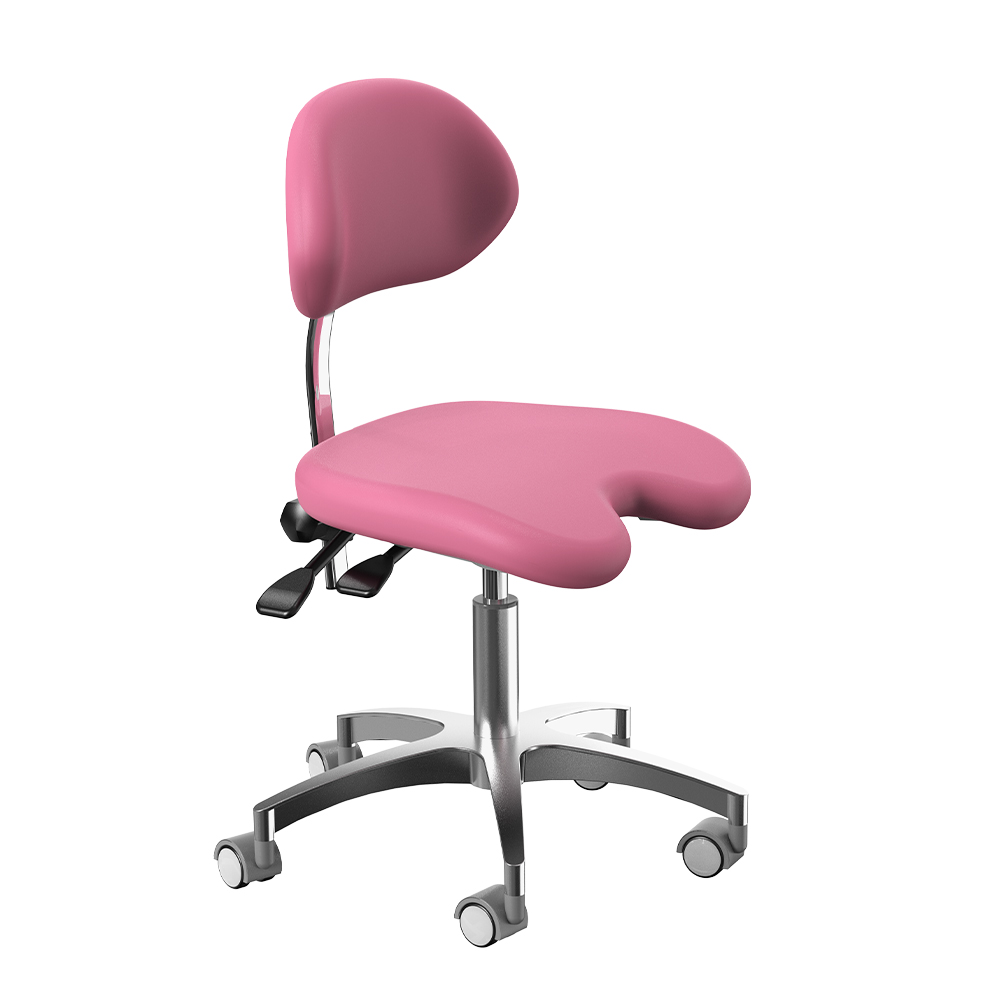
Dental ergonomics is not simply a matter of choosing a softer seat. During treatment, dentists and assistants repeatedly lean, rotate, reach, and maintain precise visual positions. Poorly matched seating can make those movements harder and encourage awkward posture. For that reason, choosing an ergonomic dental chair setup requires attention to the operator’s stool as well as the patient chair. The American Dental Association specifically identifies stool selection, backrest design, and equipment positioning as relevant ergonomic purchasing questions.
What Makes Dental Seating Ergonomic?
Ergonomic seating should help the practitioner maintain a balanced working position without unnecessarily restricting movement. Height adjustment is fundamental because the correct seat position depends on the user’s body dimensions and the working relationship with the patient’s mouth.
A useful starting point is the operator’s own posture rather than the equipment. Research examining dentist stools found that an ergonomically designed dental stool produced lower trapezius muscle activity than a conventional stool during simulated dental procedures. The researchers concluded that seating capable of supporting ergonomic posture should be used to help prevent musculoskeletal disorders.
Seat and backrest geometry also influence how easily a practitioner can move. A stool that feels comfortable while sitting still may become restrictive when the dentist needs to rotate toward an assistant, move closer to the patient, or change working position.
How Should a Dentist Adjust the Stool?
Height should be adjusted so the practitioner can maintain a stable seated position while working at the patient’s mouth. Excessive height can make the user perch toward the front of the seat, while insufficient height can alter pelvic and spinal positioning. Research on dentist posture has linked stool adjustment with maintaining a more balanced working posture.
An ergonomic dental chair arrangement should therefore be calibrated around the practitioner before the rest of the operatory is positioned. Feet should have stable support, the back should remain naturally aligned, and the operator should be able to approach the patient without excessive forward bending.
The assistant’s position deserves equal attention. FDI guidance recommends appropriate assistant seating height and foot support to facilitate access, instrument transfer, and suction while reducing stressful postures.
Does Seat Shape Really Matter?
Seat shape changes how the hips, thighs, and upper body interact with the stool. Flat seats generally permit frequent repositioning, while contoured seats provide more defined support. U-shaped designs can provide additional central clearance, and saddle seats encourage a different relationship between the pelvis and thighs.
Recent dental-equipment guidance from Roson compares these shapes according to freedom of movement, thigh support, and sitting position rather than treating one configuration as universally superior. That distinction matters because practitioners have different body dimensions and working habits.
Saddle seating can be particularly relevant for practitioners who need to work close to the patient. Its geometry can encourage a more open hip position and make it easier to move around the treatment area. However, the design still needs to match the individual user; an ergonomic label alone does not guarantee a suitable fit.
Back support presents a similar question. Some users require more lumbar support, while others prioritize freedom to rotate. A movable backrest can therefore be useful when the practitioner frequently changes position during treatment.
How Do the Stool and Patient Chair Work Together?
The operator stool cannot create good ergonomics independently. Patient height, head position, chair movement, light placement, and instrument delivery all affect how the dentist sits and reaches.
An ergonomic dental chair should bring the treatment area into a workable relationship with the seated operator. Raising or lowering the patient chair can change the dentist’s elbow and shoulder position, while headrest adjustment influences the line of sight. The objective is not to force the practitioner into one fixed position but to make routine adjustments easier.
Equipment location matters as well. ISO 4073 defines the operator stool as an adjustable movable seat supporting the oral healthcare provider or assistant and provides a framework for describing the location and adaptability of dental equipment within the working area.
Roson likewise emphasizes an operator-first approach in its ergonomic guidance: the practitioner establishes a neutral working posture before adjusting the patient and surrounding equipment. That sequence can help prevent the equipment from dictating an awkward working position.
What Should Clinics Look for in an Ergonomic Setup?
Clinics should begin with adjustability rather than appearance. A suitable stool should accommodate the user’s height, allow appropriate positioning around the patient, and provide support without obstructing normal chairside movement.
Multiple-user practices face an additional challenge. A stool that fits one dentist may not suit another clinician or assistant. Easy height adjustment and a straightforward setup routine become particularly useful when several people share the same operatory.
Roson provides dental seating and equipment information that can help buyers compare stool configurations and ergonomic features within a broader dental setup. Still, product selection should be based on the actual user’s posture, procedure types, working positions, and operatory arrangement rather than on the word “ergonomic” alone.
Ergonomic dental seating is about the relationship between person, stool, patient, and equipment. A well-designed stool can support better positioning, but its value depends on correct adjustment and coordinated operatory design. For clinics evaluating an ergonomic dental chair system, the most useful question is therefore not simply whether the chair is comfortable, but whether the complete setup makes precise dental work easier without forcing unnecessary strain.
