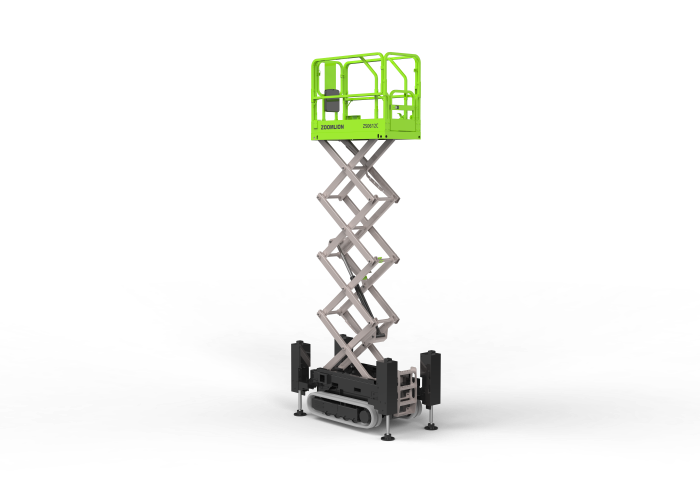
Contractors increasingly manage projects that combine finished concrete floors, paved access routes, compacted soil, gravel, and landscaped areas. Selecting access equipment for these changing conditions affects worker safety, surface protection, project schedules, and rental costs. A crawler scissor lift can help contractors reach elevated work areas where conventional wheeled platforms may struggle, but successful deployment requires careful assessment of ground conditions, machine specifications, and the planned work sequence.
For construction companies, maintenance teams, and equipment rental businesses, the objective is not simply to purchase a machine capable of crossing uneven ground. It is to match the equipment to the entire jobsite, from transportation and setup to elevated operation and relocation.
Assess Mixed Surfaces Before Selecting Equipment
A mixed-surface project should be divided into distinct operating zones. These may include smooth indoor slabs, paved entrances, gravel staging areas, soft landscaping, and unfinished construction ground. Each surface presents different challenges involving traction, bearing capacity, drainage, and the risk of damage.
Contractors should inspect the intended travel route as well as the final working position. Recently disturbed soil, concealed trenches, underground utilities, drainage channels, and unsupported pavement edges may create hazards even when the surface appears firm. Rainfall can also change ground conditions during a project.
This assessment helps determine whether a tracked machine is appropriate for the complete route or whether temporary ground protection, an alternative access method, or a revised work sequence is necessary.
Why a Crawler Scissor Lift Can Suit Variable Ground
A crawler scissor lift uses a tracked undercarriage rather than conventional wheels. Its tracks distribute the machine’s weight across a larger contact area, which can reduce ground pressure and improve traction on suitable soft or uneven surfaces. These characteristics can benefit outdoor installation, facility maintenance, and construction projects where access routes change between work zones.
However, tracks do not make every surface safe. Wet turf, loose fill, weak paving, and hidden voids can still present risks. Contractors should confirm the machine’s ground requirements and assess whether the supporting surface can withstand its operating loads.
A tracked design also involves trade-offs. Travel speed, machine dimensions, transport requirements, and the ability to maneuver through narrow passages may differ from those of wheeled alternatives. The equipment must fit the actual site rather than simply offer better traction.
Match Working Height and Platform Capacity to the Task
Working height and rated platform capacity should be checked against the planned activity. Contractors need to account for workers, tools, materials, and any additional loads placed on the platform. The deck extension, where provided, may have a separate capacity limit.
Zoomlion Access offers the ZS0612C crawler scissor lift for work at height across rough and unstable terrain. Its published specifications list a maximum working height of 7.8 meters and a platform capacity of 230 kilograms. The deck extension has a rated capacity of 113 kilograms, and the maximum number of workers is two.
These limits should guide task planning rather than be treated as interchangeable figures. The combined load must remain within the applicable rating for the area being used, while operators must follow the manufacturer’s instructions and local safety requirements.
Plan Slopes, Travel Routes, and Setup Positions
Slope assessment is particularly important when a project includes ramps, uneven ground, or transitions between paving and soil. Contractors should distinguish between a machine’s travel gradeability and its permitted working slope. Gradeability describes its ability to travel on a gradient under specified conditions; the working-slope limit governs whether the machine can safely be set up for elevated operation.
The ZS0612C specification chart lists 30% gradeability, equivalent to approximately 17 degrees, and maximum working-slope limits of 12 degrees laterally and 7 degrees vertically. These values describe different operating conditions and should not be used interchangeably. The manufacturer’s operating manual remains the controlling reference for setup, travel, and elevation.
Routes should also provide sufficient clearance for the machine, turning, and any required leveling arrangements. Where ground strength is uncertain, a competent site assessment should establish whether additional support or a different route is necessary.
Evaluate Productivity Beyond the Purchase Price
When comparing a tracked scissor lift for sale, contractors should consider total operating cost rather than purchase price alone. Relevant factors include transport, operator training, routine inspections, maintenance, spare-parts availability, equipment utilization, and potential delays caused by unsuitable access equipment.
A machine that can reach several work zones may reduce equipment changes or the need to coordinate separate access solutions. However, that benefit depends on whether the machine can safely travel between those zones and perform the required tasks within its operating limits.
The ZS0612C has a listed stowed drive speed of 2 kilometers per hour. Contractors should account for this when scheduling relocations, particularly across large sites. Its CE certification is also relevant when evaluating equipment for markets where the applicable conformity requirements recognize that certification; buyers should verify the requirements for their intended location.
Build Safety and Surface Protection Into the Work Plan
Before operation, contractors should arrange pre-use inspections, confirm operator competence, review emergency procedures, and establish exclusion zones where required. Particular attention should be paid to ground conditions, track condition, controls, brakes, guards, and emergency-lowering systems.
Surface protection also deserves a specific plan. Rubber tracks may be better suited than wheels to some sensitive or soft surfaces, but they do not guarantee damage-free travel. Turning, repeated passes, moisture, and concentrated loads can affect turf, paving, and finished floors.
Where necessary, contractors can consider suitable protective mats, controlled access routes, and designated staging areas. The site plan should also specify when work must stop because of changing weather or deteriorating ground conditions.
Choose Equipment Around Real Project Requirements
For contractors comparing a tracked scissor lift for sale, the most useful selection process begins with the worksite rather than the product catalogue. Surface conditions, working height, rated loads, slope limits, transport access, and maintenance support should all inform the decision.
Zoomlion Access‘s ZS0612C provides a defined set of specifications for contractors evaluating tracked access equipment, including 7.8 meters of working height and a 230-kilogram platform capacity. Its suitability for a particular project still depends on site conditions and operating requirements.
By planning routes, verifying load and slope limits, and budgeting for transport and upkeep, contractors can make a more informed investment in a crawler scissor lift. This approach helps align equipment selection with practical site demands while keeping productivity and safe operation central to the plan.
