Modern power systems continue to evolve as industries demand higher power density, improved thermal performance, and more compact electronic designs. These changes have encouraged engineers to evaluate transformer technologies that better fit switching power supplies, industrial equipment, communication devices, and renewable energy systems.
When selecting a magnetic transformer supplier, design compatibility, manufacturing capability, and application knowledge are often considered alongside electrical performance. Companies such as Mentech support these engineering needs by developing customized magnetic components for different industries, including planar transformers used in modern power conversion.
Understanding Why Planar Transformers Are Different
Unlike conventional wire-wound transformers, planar transformers use flat copper conductors combined with specially designed magnetic cores. This structure reduces winding height while creating a larger surface area for heat transfer. As switching frequencies continue to increase in modern power electronics, this structural advantage becomes increasingly valuable for thermal management.
The flat winding arrangement also helps reduce leakage inductance and improves consistency during manufacturing. Since conductor geometry is precisely controlled through printed circuit boards or copper layers, engineers can achieve more repeatable electrical characteristics across production batches. These factors make planar transformers suitable for applications where design consistency is important.
For design teams evaluating a magnetic transformer supplier, understanding manufacturing processes is just as important as reviewing electrical specifications. Stable production methods and application-specific customization often influence the long-term reliability of power conversion equipment.
Why Modern Power Systems Continue to Adopt Planar Transformers
Many modern power systems require smaller footprints without reducing electrical performance. Data centers, communication equipment, industrial automation, and distributed power architectures all place significant pressure on component size. Planar transformers help designers reduce vertical space while maintaining efficient magnetic coupling.
Improved thermal behavior is another important reason for wider adoption. The larger conductor surface allows heat to spread more effectively than traditional round-wire windings. Better heat dissipation can simplify thermal design and reduce the need for additional cooling measures in certain applications.
High-frequency operation also benefits from planar structures. Modern switching power supplies commonly operate at frequencies that favor carefully controlled winding layouts. The lower parasitic effects of planar transformers support more predictable performance in these environments.
Design Considerations Engineers Should Evaluate
Selecting a planar transformer requires balancing electrical, thermal, and mechanical requirements rather than focusing on only one parameter. Core material, switching frequency, insulation requirements, winding configuration, and power level should all be evaluated together during system design.
Mechanical integration is equally important. SMT-compatible planar transformers simplify automated assembly while reducing manual production steps. Engineers should verify mounting methods, PCB layout compatibility, and available installation space before finalizing component selection.
Application requirements may also influence transformer architecture. Power modules, PoE equipment, DC-DC converters, and industrial control systems each present different operating conditions. Working with an experienced magnetic transformer supplier can help ensure that winding design, inductance, and turn ratio are optimized for the intended application.
Example of a Planar Transformer for PoE Applications
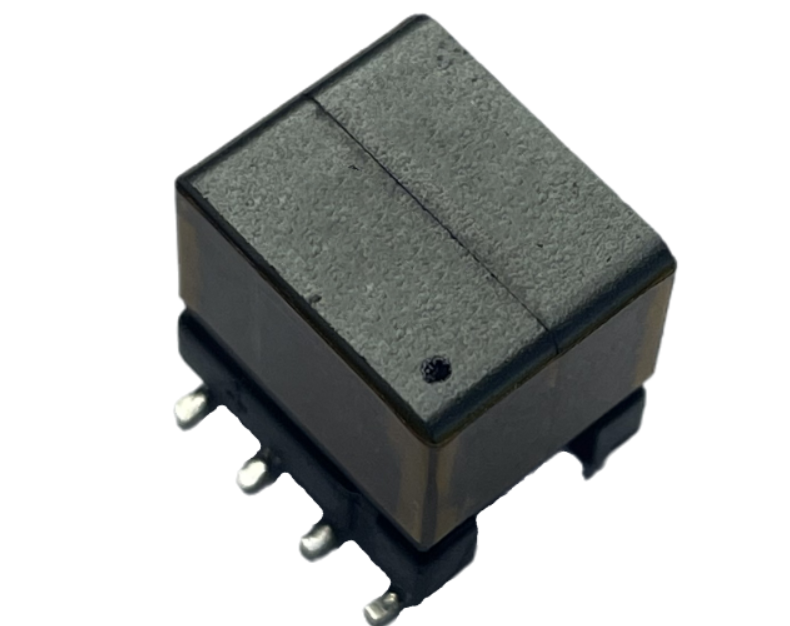
One example is the EP-523SG planar transformer, which is designed for PoE applications requiring compact installation. Its dimensions are 13.3 × 10.0 × 9.5 mm, allowing integration into space-constrained electronic assemblies without significantly increasing board height.
The component uses SMT mounting for automated production processes. It provides an inductance of 310, a power rating of 3, and a turn ratio of 1:0.19:0.7. These specifications make it suitable for designs that require controlled magnetic performance within PoE power architectures.
Rather than serving as a universal solution, engineers should evaluate whether these specifications align with their system requirements, including operating frequency, PCB layout, thermal conditions, and overall circuit topology before product selection.
Manufacturing Quality Matters as Much as Electrical Design
Transformer performance depends not only on design calculations but also on manufacturing precision. Variations in core assembly, winding alignment, insulation processing, or solder quality may affect electrical consistency across production lots.
Reliable production requires controlled material selection, dimensional inspection, and electrical testing throughout manufacturing. Repeatable processes become particularly important for industries such as communication equipment, industrial electronics, and automotive systems, where long-term operational stability is expected.
This is why many engineering teams evaluate the production capability of a magnetic transformer supplier alongside technical specifications. Stable manufacturing systems help maintain consistency when products move from prototype development to large-volume production.
How Customized Magnetic Solutions Support Different Industries
Power electronics applications often require more than standard catalog components. Different switching frequencies, voltage ranges, and installation environments frequently require customized magnetic designs to match system objectives.
Besides planar transformers, Mentech develops customized magnetic components for multiple industries. Their product portfolio includes high-frequency electronic transformers, PFC inductors, common-mode and differential-mode inductors, molded power inductors, and automotive magnetic components such as OBC transformers, DC-DC transformers, drive transformers, BMS transformers, and filter inductors.
They also provide magnetic products for communication and solar-storage-charging applications, including traditional LAN transformers, chip LAN transformers, common-mode inductors, differential-mode inductors, micro-inverter transformers, and high-power DC-DC transformers. This broad product range allows them to support different stages of magnetic component development for industrial customers.
Conclusion
Planar transformers have become an important option for engineers developing compact, high-frequency power systems because they combine efficient thermal behavior, consistent electrical performance, and space-saving construction. Successful implementation depends on matching transformer specifications with actual application requirements while considering manufacturing quality throughout the product lifecycle.
For companies seeking a magnetic transformer supplier, Mentech provides customized magnetic component development across power modules, communication systems, new energy, and PoE applications, including products such as the EP-523SG that address practical engineering requirements.
