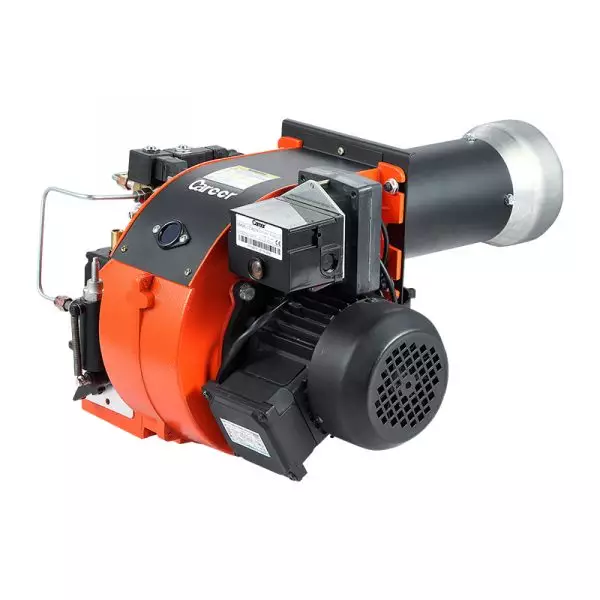
High-temperature industrial furnaces require combustion equipment that provides consistent heat while responding to changing process demands. An oil burner must do more than generate a flame; it must maintain controlled combustion and deliver usable thermal input throughout the furnace cycle.
Oil-fired systems can perform effectively in demanding industrial heating environments when burner capacity, fuel characteristics, combustion regulation, and furnace configuration are properly matched. Their performance is therefore determined by the relationship between the burner and the furnace rather than by burner output alone.
Can Oil Burners Deliver Stable Heat in High-Temperature Furnaces?
Yes, oil burners can provide stable heat for high-temperature industrial heating when their firing range corresponds to the furnace’s actual thermal requirement. A correctly matched burner supplies enough energy to reach the target process condition without operating continuously outside its intended range.
Career Burner lists light-oil burners covering a power range of 24–1,416 kW and a fuel capacity range of 0.75–35 GPH. The range includes models intended for different industrial heating requirements, from smaller systems to heavier-duty installations.
Heat demand remains the deciding factor. Furnace production rate, material load, heating cycle, and heat losses determine how much firing capacity is actually required. A burner should therefore be evaluated according to its operating range rather than maximum output alone.
How Do Oil Burners Maintain Combustion at High Furnace Loads?
High furnace loads place greater demands on fuel delivery, atomization, air supply, and flame stability. Consistent combustion requires these elements to remain properly coordinated as the burner operates.
Career Burner’s oil burner furnaces category covers light-oil equipment using fuels including diesel, kerosene, and Bio 10 oil. The collection is described as providing stable combustion and energy efficiency across different applications.
Fuel preparation is particularly relevant because liquid fuel must be properly handled and atomized before combustion. The operating fuel conditions should correspond to the selected burner’s requirements, while fuel filtration and regular maintenance help preserve consistent operation.
A well-matched oil furnace burner can consequently maintain useful heat input at demanding loads without treating maximum firing rate as the only measure of performance.
How Does Burner Regulation Affect High-Temperature Performance?
Regulation determines how closely burner output can follow the furnace’s changing heat demand. A furnace that moves between warm-up, full-load heating, and temperature holding may require more than simple fixed firing.
Career Burner offers light-oil burners with several regulation configurations, including single-stage and two-stage regulation, manual on-off control, and modulation control. The available configuration depends on the individual burner model.
A high efficiency oil burner should therefore be judged partly by how its control arrangement corresponds with the process. Two-stage or modulating operation can provide a way to adjust firing more closely to changing demand where the selected model supports that configuration.
Control also influences how the burner interacts with the furnace’s temperature-management system. Appropriate regulation can help avoid unnecessary full-load operation when the process requires less heat.
Why Does Furnace Compatibility Determine Burner Performance?
Even a capable burner may perform poorly if it is not properly integrated with the furnace. Combustion equipment must correspond with the heating unit’s capacity, installation arrangement, fuel system, electrical requirements, and control architecture.
Career Burner states that its oil burner range can be customized according to fuel type, output range, control systems, and installation styles. This flexibility is relevant to industrial projects where existing equipment or process requirements make a standard configuration unsuitable.
Physical integration also affects practical operation. Burner mounting, fuel connections, combustion-air supply, and access for maintenance should be reviewed before installation. The furnace and burner should be treated as one thermal system rather than two independent pieces of equipment.
Can Oil Burners Maintain Performance During Extended Operation?
Long operating periods make component condition increasingly important. A burner that performs correctly during initial commissioning still depends on clean fuel, appropriate air-to-fuel adjustment, functioning ignition equipment, and properly maintained components.
Career Burner describes its light-oil burners as using high-quality components intended for demanding industrial environments and long-term use. The product range also emphasizes reduced maintenance requirements as part of its design approach.
Maintenance should focus on preserving the conditions under which the burner was designed to operate. Fuel filters, burner components, ignition systems, and combustion settings should be inspected according to manufacturer requirements.
Consistent maintenance is particularly important in high-temperature processes because changes in combustion conditions can affect the stability and repeatability of heat delivery.
What Determines Overall Performance in a High-Temperature Furnace?
Oil burners can perform effectively in high-temperature industrial furnaces when five conditions remain aligned: sufficient thermal capacity, appropriate fuel delivery, stable combustion, suitable regulation, and correct furnace integration.
The available Career Burner range demonstrates why model selection needs to consider more than nominal firing rate. Its light-oil collection spans different capacities and includes multiple control configurations, allowing equipment characteristics to be matched with different industrial heating requirements.
Performance should therefore be assessed through the burner’s actual operating range and its relationship with the furnace. A high efficiency oil burner is not automatically the best choice simply because it has a higher rated output; its combustion and control characteristics must suit the process.
An oil furnace burner delivers reliable high-temperature results for industrial users only when it is correctly sized, integrated, regulated, and maintained within specific operational limits. True high-temperature performance is a holistic system outcome, not a metric determined by capacity alone.
